
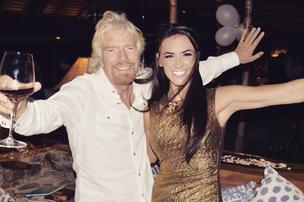
Britnie Turner capped 2014 in the best way possible: One week on the private island of the executive she most admires.
British billionaire Richard Branson recently hosted Turner and other entrepreneurs on his private island, named Necker Island. It’s a 74-acre island within the British VirginIslands. There were 30 entrepreneurs in all; to qualify, you had to be doing at least $10 million in annual revenue.
The trip was organized through the Entrepreneurs’ Organization. Turner learned of the trip from someone she had met in Charlotte a decade ago, while training to be a missionary in Africa.
Turner employs 19 people at Aerial Development Group. She’s expanding into Knoxville and Savannah, Ga. Locally, she is broadening her focus beyond single-family homes by pursuing Wedgewood Lofts, in the Wedgewood-Houston neighborhood.
For Turner, 26, this would be her first mixed-use development. It involves 150 units and 10,000 square feet of retail. She is seeking financing for the roughly $20 million project.
Contrast that with Branson, who’s 64 years old and creator of Virgin Group, a conglomerate consisting of 400 companies. Nashville is becoming more familiar with Branson, now that Virgin is scheduled to operate a 19-story luxury hotel planned for the Music Row roundabout.
Turner hoped to soak up that business experience. Here are the highlights from my recent conversation with her about the trip.
Why the interest in Richard Branson?
He is the only famous person I’ve ever wanted to meet.
Two years ago, one of my sisters gave me one of his books. I liked his concept. I had to know if it was real. Being in a stuffy business is not for me, and he is great about avoiding that.
From that point, I was on a mission to meet him, and not just at some conference for a handshake.
One week on Branson’s private island. What were your expectations going in?
I expected maybe we’d meet him once at a dinner, for 10 minutes.
He poured wisdom into us. He spent six hours a day with us. He was at every dinner. They were all themed: superheroes, tennis and golf pros, tribal night, all-white.
Have to ask: Which superhero were you?
I was definitely Wonder Woman!
What other types of businesses did the other entrepreneurs run?
Technology, investments, medical. … The one that surprised me was a pine-straw recycling business.
What did you make of Branson? What is still sticking with you today
There were many things. Mainly, he has an abnormal level of belief that he can do something. He didn’t wait for his legacy to start.
The overwhelming sense I got is, the visionary doesn’t have to look like what you think they should. I’m in an all-man industry, and they’re not always nice about it, and they don’t often take you seriously.
He showed me I don’t need to hire someone to replace me who is a better cookie-cutter image of what the CEO is supposed to be. You might not be the standard, but you can still be a game-changing CEO.
He’s been the laughing stock of Wall Street because he’s not the normal CEO. He has pure fun. That style is the future.
He has a shrine of ties that he has cut off. So if you meet him, I’d suggest not wearing a tie.
What were your top business takeaways?
Well, he has severe dyslexia. That’s his greatest handicap; it’s why he quit school at 15.
But if it weren’t for dyslexia, he wouldn’t be close to being him. He has had to delegate and trust others to do good work. He gave me a new appreciation for how much you can count on the people in your organization. He can’t even send an email.
Did you get much of a one-on-one audience with him?
At one dinner, it was Q&A with Richard. My question to him was: What are most entrepreneurs missing right now?
He said they don’t really understand how forceful their businesses can be for the better good. He talked about how he breaks out a social and environmental P&L for his businesses. He literally starts businesses to force the change he wants to see.
The biggest thing I took away was how to truly become a social venture company. We have since strictly focused on developing to strategically address social needs. We have implemented tracking a social and environmental P&L in addition to our regular P&L so the staff can see on a quarterly difference the kind of impact our work has.
A lot of our homebuyers want to be part of something bigger than themselves. Building houses is cool, but this is what really gets us going – creating change. [For every home Aerial sells, the company sponsors a child in a Kenyan orphanage for a year, in the buyer’s name].
It is cool how he sees business as a tool to accomplish what you want to do on Earth, not just a place to go to work. Just another reason people should start a business.
How has his advice or perspective changed how you run Aerial?
I’m always working toward something. He helped me understand the day-in, day-out of how to get there.
I did not expect my vision for what is even possible to accomplish in one lifetime to be expanded to the extreme that it was. We have been inspired to start a few other companies and have since ventured into different asset classes in real estate.
I was surprised how much he knew about all of his businesses, and just the mastery he has of his brand. As a 26-year-old girl, it certainly can be overwhelming to say you are confidently leading your company into the billions of dollars in revenue. But that’s what I want my company to be.
Original article: http://www.bizjournals.com/nashville/blog/real-estate/2015/03/q-a-nashville-ceo-on-a-week-with-billionaire.html